
Garage, lanai and shop floors in South Miami-Dade
Epoxy Flooring in Homestead, FL
Concrete coatings planned for heat, sun and wet-season moisture, starting with a ground slab and a moisture reading.
- Free on-site estimates with a slab moisture reading
- Written quote listing the prep, each coat and the price
- UV-stable topcoats on garage and outdoor floors
Floor Coatings Built for Homestead Concrete
Epoxy flooring in Homestead goes down on concrete that lives in a hot, wet place. The city sits about 3 feet above sea level between Everglades and Biscayne National Parks. Wikipedia's climate data puts its yearly rainfall near 60 inches, spread over about 139 rain days, with most of it falling from mid-May to early October. Summer highs average 90 to 92°F. A coating here has to deal with damp slabs, hard sun at the garage door and on the lanai, and the dirt and standing water that come with farm country.
A young housing stock, rebuilt after Andrew
Hurricane Andrew hit South Miami-Dade on August 24, 1992, and Homestead was among the hardest-hit places. The storm destroyed 99% of the city's mobile homes and most of the buildings at Homestead Air Force Base. Rebuilding and fast growth followed. American Community Survey figures for 2019 to 2023, summarized by Point2Homes, give Homestead a median year built of 2001, with about 38% of its homes built between 2000 and 2009. About 21% of units are townhomes or other attached single-family homes and 39% are detached houses. That puts many garage slabs here at roughly 17 to 26 years old. They are usually structurally sound, and they often carry tire marks, rust rings from tools and bikes, hairline shrinkage cracks, and a builder's sealer or kit paint that has started to lift.
Moisture under the slab
Homestead sits on porous limestone. The Biscayne Aquifer, a shallow layer of highly permeable limestone that supplies water from Homestead to Delray Beach, is unconfined, which means its top is the water table itself. In the wet season the ground under a slab stays damp, and water vapor can move up through concrete that has a thin or damaged vapor barrier. Trapped moisture is the most common reason a coating blisters or lets go in South Florida. We take a moisture reading before we recommend anything. Where readings run high, we use a moisture-tolerant primer or a polyaspartic system, which HomeGuide notes can go over concrete with higher moisture content than epoxy.
Sun, heat and topcoats
Plain epoxy does poorly in sunlight. HomeGuide rates epoxy's UV resistance as poor to fair and polyaspartic as excellent. In a garage where the afternoon sun comes through an open door, or on a patio, an epoxy-only floor can yellow and turn chalky. Our garage and outdoor floors finish with a UV-stable polyaspartic or urethane topcoat. Outside, we steer toward lighter colors and a textured finish, because a dark, glossy surface gets hot underfoot and slick after a summer storm.
Systems we install
- Flake garage floors: a base coat, a full broadcast of vinyl color chips and a clear polyaspartic topcoat that hides dust and tire marks.
- Polyaspartic systems: fast-curing and UV-stable, so you can usually park again within a day or two.
- Patio, lanai and pool deck coatings: textured, light-colored finishes for concrete outside the house.
- Metallic epoxy: a poured, swirled finish for indoor slab rooms, home offices and bars.
- Shop and commercial floors: thicker 100% solids systems for nurseries, packing rooms, auto shops and storage bays.
What every installation includes
- Measuring, a moisture reading, and notes on cracks, stains and old coatings
- Diamond grinding of the whole slab, edges included, then dust removal
- Crack, chip and control joint repair
- Base coat, flake or color layer, and a UV-stable topcoat
- Written cure times: when to walk on it, when to move things back, when to park
Floors and storm season
Homestead has seen more than one storm since Andrew. Wikipedia notes flooding from Katrina in 2005, damage to the Speedway from Wilma that same year, and power loss plus a week without waste pickup after Irma in 2017. A coated garage floor will not keep floodwater out. It does clean up faster, because mud and debris sit on a sealed surface instead of soaking into bare concrete. If your garage has taken water before, we look for efflorescence, staining and weakened concrete at the estimate and price the repair along with the coating.
Where We Work
Homestead and Florida City are the center of our service area. We also coat floors in Leisure City, Naranja, Princeton, Redland, Homestead Base, Goulds, Cutler Bay, Palmetto Bay, Country Walk, South Miami Heights, West Perrine, Richmond West, Richmond Heights, Three Lakes, Palmetto Estates, The Hammocks, Kendall West, Kendall, Pinecrest and Key Largo. Conditions change as you move around. Princeton grew about 78% between 2010 and 2020, so many of its garages are recent builds. In Redland, new homes generally sit on at least 5 acres, and barns, sheds and equipment slabs need coating as often as garages do. In Country Walk, Andrew destroyed about 90% of the homes, and many were rebuilt with concrete walls. Each area page covers what we found there.
- Epoxy Flooring in Homestead, FL
- Epoxy Flooring in Florida City, FL
- Epoxy Flooring in Leisure City, FL
- Epoxy Flooring in Naranja, FL
- Epoxy Flooring in Princeton, FL
- Epoxy Flooring in Redland, FL
- Epoxy Flooring in Homestead Base, FL
- Epoxy Flooring in Goulds, FL
- Epoxy Flooring in Cutler Bay, FL
- Epoxy Flooring in Palmetto Bay, FL
- Epoxy Flooring in Country Walk, FL
- Epoxy Flooring in South Miami Heights, FL
- Epoxy Flooring in West Perrine, FL
- Epoxy Flooring in Richmond West, FL
- Epoxy Flooring in Richmond Heights, FL
- Epoxy Flooring in Three Lakes, FL
- Epoxy Flooring in Palmetto Estates, FL
- Epoxy Flooring in The Hammocks, FL
- Epoxy Flooring in Kendall West, FL
- Epoxy Flooring in Kendall, FL
- Epoxy Flooring in Pinecrest, FL
- Epoxy Flooring in Key Largo, FL
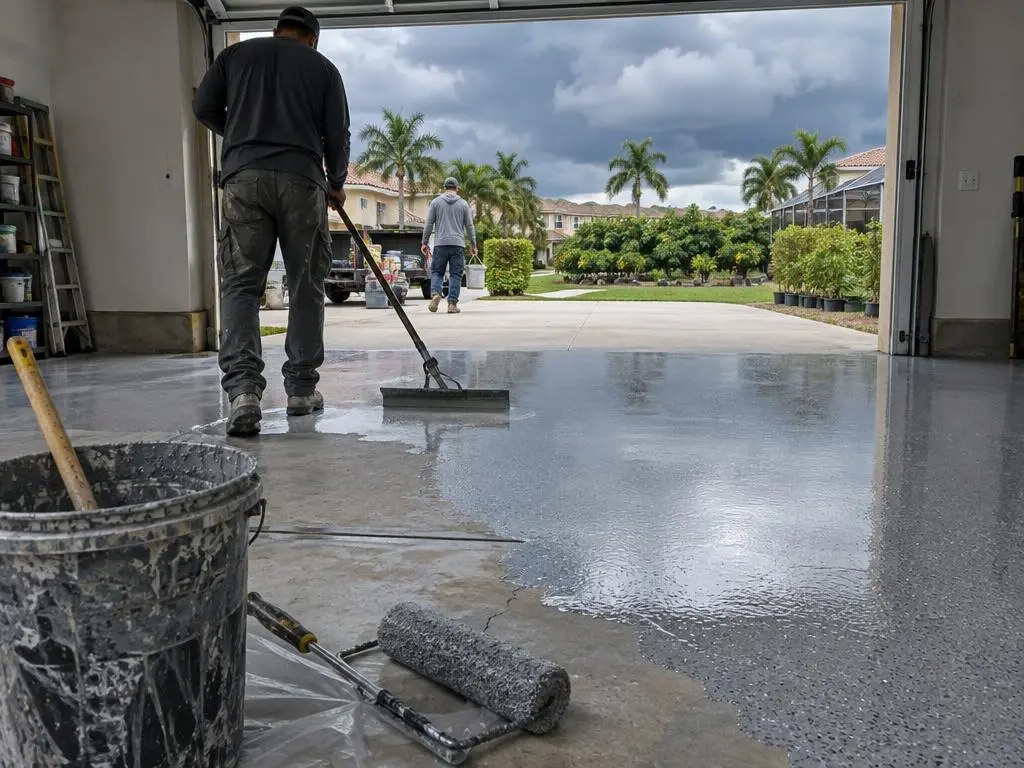
Our Epoxy Flooring Services
Six coating services for the concrete South Dade homes and businesses actually have: sun-struck garages, wet-season slabs, pool decks and hard-working farm and shop floors.
Garage Floor Coating
Ground, repaired and coated garage slabs with a UV-stable topcoat for the afternoon sun that comes through a Homestead garage door.
Learn more →Epoxy Flake Floors
Full-broadcast color chip floors that hide dust, tire marks and tracked-in soil, with texture for wet feet.
Learn more →Polyaspartic Floor Coating
Fast-curing, UV-stable coatings that handle sun and humidity, so you can park again in about a day or two.
Learn more →Patio & Pool Deck Coatings
Textured, light-colored coatings for patios, lanais and pool decks that take full sun and summer storms.
Learn more →Metallic Epoxy Floors
Poured, swirled metallic finishes for living areas, home offices, bars and showcase garages on slab-on-grade homes.
Learn more →Commercial & Shop Floor Epoxy
Thicker resin systems for nurseries, packing rooms, auto shops, warehouses and storage bays across South Dade.
Learn more →Common Questions
How much does epoxy flooring cost in Homestead?
HomeGuide's national range for installed epoxy is about $4 to $10 per square foot, or $1,600 to $5,800 for a two-car garage. Polyaspartic runs about $5 to $12 per square foot, or $2,000 to $6,900 for a two-car garage. Removing an old coating, fixing cracks or treating a damp slab adds to the total. We give you a written price after we see the floor.
How much does 1,000 square feet of epoxy cost?
At HomeGuide's $4 to $10 per square foot, 1,000 square feet comes to about $4,000 to $10,000 for epoxy, and about $5,000 to $12,000 at its polyaspartic range. HomeAdvisor lists commercial 100% solids coatings at $12 or more per square foot, so a shop or warehouse floor of that size can run higher. Prep and moisture conditions move the number, which is why we price on site.
What are the disadvantages of epoxy flooring?
Epoxy needs a dry, well-prepared slab and can blister if moisture comes up from below. HomeGuide notes long cure times (up to a week for solid epoxy), brittleness in extreme temperatures and poor UV resistance, and a glossy surface can be slick when wet. In Homestead we handle those with a moisture reading, a UV-stable topcoat and added texture.
Can you install an epoxy garage floor during the rainy season?
Yes, with planning. Rain itself is less of a problem than humidity and dew point, because moisture condensing on the slab or between coats can cloud the finish and weaken the bond. We check conditions on the day, keep the garage door down while coats cure, and use polyaspartic where it fits. If a day looks wrong, we reschedule.
Is epoxy or polyaspartic better for a Florida garage?
Many South Florida garages do well with both: an epoxy or polyaspartic base and a polyaspartic topcoat. HomeGuide rates polyaspartic's UV resistance as excellent and epoxy's as poor to fair, and polyaspartic cures in about 1 to 2 days versus up to a week. Epoxy builds thickness at a lower cost. We decide after seeing how much sun and moisture your floor gets.
What should I ask when comparing epoxy installers?
Ask how they prepare the concrete (diamond grinding or acid etching), whether they test for moisture, how many coats go down and what the topcoat is, and what is written on the quote. Ask to see photos of floors that have been in use for a year or more. A clear written scope makes quotes easy to compare.
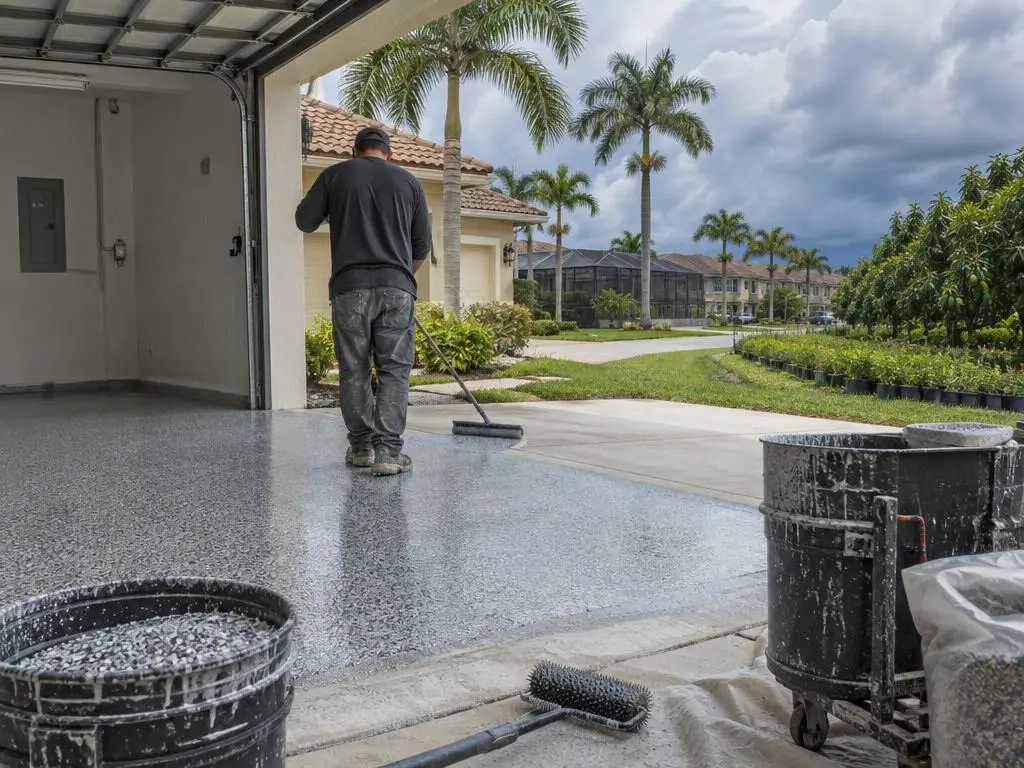
Why Homeowners Call Epoxy Flooring Homestead
Moisture read before we quote
South Dade slabs sit over a shallow limestone aquifer. We test the concrete first so the primer and system fit the slab.
Topcoats made for sun
Garage and outdoor floors get a UV-stable topcoat so the color holds where afternoon light hits it.
Work planned around the weather
We check humidity and dew point on install day and move the job if conditions would hurt the cure.
One written price
Your quote lists the square footage, the prep, each coat and the total. Any change in scope is written up for you to approve first.
Get an Epoxy Flooring Estimate
Free on-site estimates in Homestead, Florida City and across South Miami-Dade.